
What the nose of a windowsill is and why you need it
The word “kapinos” is known to fitters, while a customer more often meets it in an order or a sill description and does not understand why to pay for a “nose”. Yet it is one of the most useful details: it decides whether the wall under the window is still dry a year or two later. We explain in plain language how it works, which kinds exist and when, on the contrary, it is better to remove it.
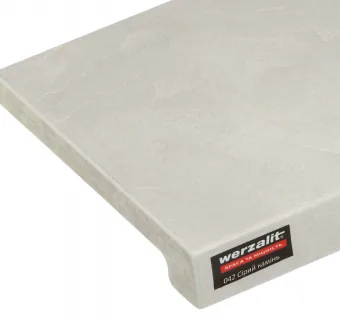
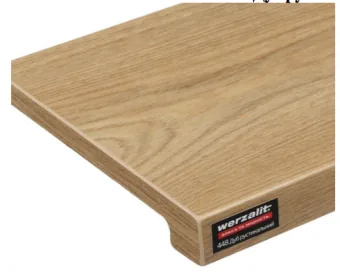
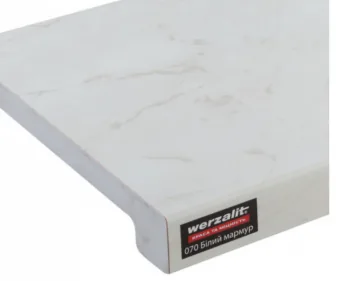
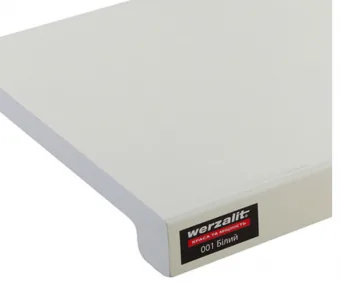
What the nose is: a canopy for water
Look at a windowsill from the side. Its front edge is not flat: it ends in a small lip turned downwards. That is the nose (in Russian “kapinos”, from “to drip”: water drips off it). Compare it with a house: it is like the canopy over a porch, which keeps water from running down the wall and carries it down and away.
You may also hear “drip edge”: it is the same thing.
What it is for: the path of a drop
Condensation on the glass, rain after an open window, water from cleaning: all of it ends up on the sill. Here is what happens next:
- The water gathers on the sill and runs to the front edge.
- At the edge it has to go round the projection and starts creeping down its underside.
- The lip turned downwards ends in a sharp edge: the water gathers into a drop there.
- The drop breaks away and falls down without touching the wall.
Without a nose the water clings to the underside of the slab and reaches the wall, leaving dark streaks and in time ruining paint, plaster and wallpaper.
Fitter’s tipIf you open the window in the morning and see a wet sill, that is normal, especially in the heating season. If the sill has a nose and the joint under the frame is sealed, the wall is in no danger.
Two more reasons to like the nose
- A stiffer edge. The lip turned downwards works as a stiffening rib: the edge bends less under load and a long sill does not rock.
- A finished look. A massive crisp edge with a shadow looks neater than the plain cut of a slab and underlines the line of the sill.
- The nose also protects the finish of the bottom of the reveal and the wall: account for it when calculating the overhang (30–50 mm from the plane of the wall to the edge).
- In visualisations and sections use the profile height with the nose, 34 mm for Exclusive, not only the 17 mm thickness of the slab: it affects the height of gaps under curtains and furniture.
The nose on Werzalit Exclusive
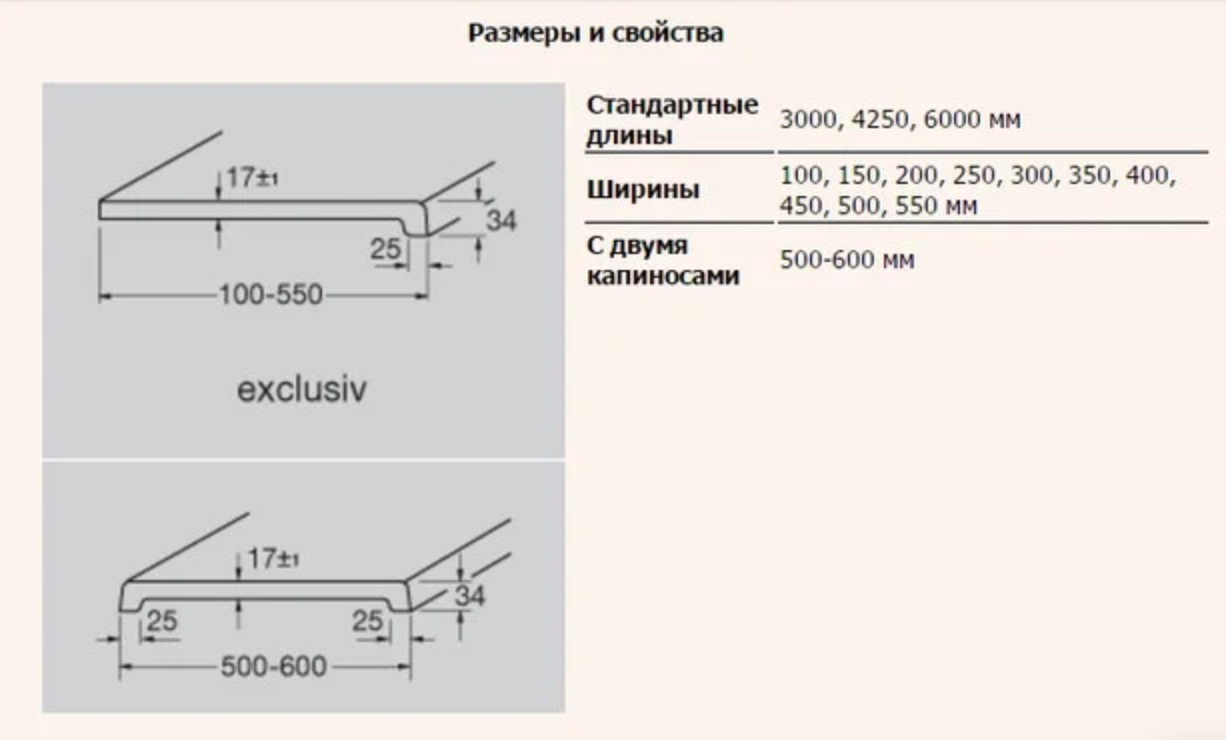
The Exclusive series has a pronounced nose. The dimensions of the profile according to the manufacturer:
| Thickness of the sill | 17 ± 1 mm |
|---|---|
| Nose (projection) | 25 mm |
| Profile height with the nose | 34 mm |
| Width with one nose | 100–550 mm |
| Width with two noses | 500–600 mm |
| Standard lengths | 3000, 4250, 6000 mm |
The Compact series is a lighter profile for standard openings. The article “How to measure a window and choose a windowsill” helps you compare the series.
One nose or two
Sills up to 550 mm wide have one nose, at the front. For wide openings (500–600 mm) the manufacturer makes a profile with two noses: a wide slab gets an extra stiffening rib and keeps its shape better. You do not have to choose: the variant depends on the chosen width.
Overhang and nose: how they differ
These two words are often confused. The overhang is how far the slab projects beyond the wall into the room. The nose is the turn on the edge of that slab. So the nose sits at the very edge of the overhang. When you choose the width of the sill (how to do it), you allow for an overhang of 30–50 mm, and the nose is already part of the profile.
When the nose has to be trimmed
Sometimes the projection gets in the way and the sill has to be laid tight against something. Typical cases:
- the sill is installed in a niche or between two walls and no overhang is needed;
- the sill continues as a worktop or butts against furniture;
- there is projecting trim around the window that the nose would catch on.
In these cases nose trimming is ordered: 80 UAH per linear metre. It is better to do the trimming while the order is prepared so that the cut is even: cutting and cut-out services. After trimming the cut has to be protected: closed with an end cap where possible and treated with sealant at the junction with the wall.
If you removed the noseWithout the projection water can reach the wall. Seal the joint between the sill and the wall thoroughly and keep an eye on it.
Questions beginners ask most often
- Does the nose get in the way of cleaning the window? No: it is underneath and at the front, nothing changes on the sill.
- Can you bump into it? The projection is small (25 mm) and rounded, in practice it does not get in the way.
- Is it needed above a radiator? Yes, but above a radiator the gap and the cut-outs for grilles matter more: “Windowsill and radiator”.
Frequently asked questions
Can I order a windowsill without a nose?
Yes. The nose is trimmed on request; the service is called “nose trimming” and costs 80 UAH per linear metre.
Does the nose get in the way of curtains or a radiator?
Usually not: the overhang is small and sits above the radiator. If you need a larger gap or ventilation above a radiator, read the article “Windowsill and radiator”.
How do Exclusive and Compact differ at the edge?
Exclusive has a pronounced nose, Compact a lighter profile. The exact dimensions of Exclusive are in the table above; for Compact ask the manager.
Why does a sill have two noses?
For wide openings (500–600 mm) the manufacturer makes a profile with two noses: a wide slab gets an extra stiffening rib.