
Caring for a windowsill and a tabletop: what to do and what to avoid
The good news: a Werzalit windowsill and tabletop need no special care. The bad news: a few habits still shorten their life. We have collected a short everyday guide, ways to remove common stains and a list of things better not to do.
What is known about the surface
Werzalit windowsills and tabletops are made of pressed wood chips with a multilayer surface pressed together with the core. According to the manufacturer the surface withstands moisture, temperature swings, scratches and household detergents, and brief heating up to 180 °C leaves no marks. That is why almost no care is needed, but sensible rules still extend the life.
The first days after installation
The most vulnerable period for a windowsill is the first day. Mounting foam and sealant are still gaining strength, and any pressure can shift the piece or leave a gap.
- For the first 24 hours put nothing on the sill and do not lean on it.
- For the first 2–3 days avoid heavy pots and sharp loads on the overhang.
- After a week inspect the joint under the frame and at the wall: it should be even, without cracks or peeling.
- The film on the overhang is removed only when all the dirty work around is done (filler, painting the reveals).
Daily and weekly care
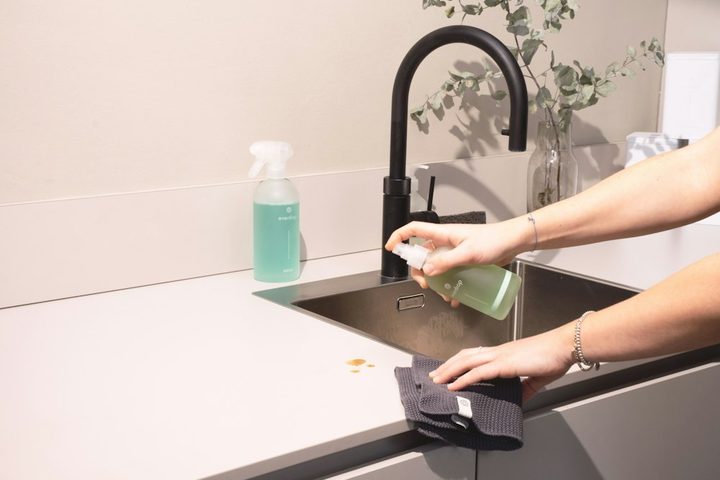
- Every day: wipe the surface with a soft damp cloth or sponge.
- Once a week: wash with warm water and a little ordinary dish soap, then wipe dry so no streaks remain.
- Once a year: check the joints and the junction with the frame and the wall, renew the sealant if needed and re-fix the end caps if they have loosened.
How to remove common stains
| What happened | How to remove |
|---|---|
| Coffee, tea, juice | Warm water with a drop of dish soap, then wipe dry. The fresher the stain, the easier. |
| Grease, oil | Warm water with dish soap, a soft sponge. |
| Limescale from drops | A weak solution of citric acid or vinegar, then rinse well with water and wipe dry. |
| A mark from a marker or pen | A soft cloth with a little alcohol; test on an inconspicuous spot first. |
| Rings from flower pots | A damp cloth with detergent; to prevent a repeat, put the pots on saucers. |
Any product you have not used before should first be tried on an inconspicuous spot.
Flowers, radiator and sun
- Pots go on saucers or stands: water from an overfilled saucer runs onto the joint first, and you do not notice at once.
- Water carefully. A single spill is no problem, but water that stands all the time gradually spoils the joint and the ends.
- Sun. Dark decors on a sunny side get hotter; do not put hot things on them and do not cover them with dark film.
- A radiator under the window. Warm air must rise along the glass. If a wide sill covers the radiator, read “Windowsill and radiator”.
If a problem has already appeared
| What you see | Why | What to do |
|---|---|---|
| A gap between the sill and the frame | The joint cracked or was not airtight | Clean the joint, dry it and apply fresh sealant |
| An end cap has come off | The glue weakened or the cap did not seat fully | Clean and glue it again; a new pair can be bought separately |
| The sill moves slightly | No support under the overhang or the foam has settled | Add a support or glue in a wedge without loading the edge |
| A dark mark by the cut edge | Water reached an unprotected end | Dry it and close the cut with sealant or a cap |
| A scratch | Mechanical damage | A small one can be masked with furniture wax matching the decor |
If you are not sure of the cause, send us a photo and we will tell you what to do.
For site managers and designers
- A short care sheet: soft cloth, ordinary dish detergent, no abrasives.
- A ban on loading for 24 hours after installation and advice not to remove the film until finishing is done.
- Contacts for ordering spare end caps: they are cheap, but on site they tend to get lost.
- The term and conditions of the warranty: Warranty and returns.
What is better not to do
- Do not use hard abrasive powders and metal scouring pads: even a tough surface can lose its even look.
- Do not cut food directly on the surface: use a chopping board.
- Do not leave hot cookware for long: the surface tolerates brief contact, but a stand is safer for hot pans and pots.
- Do not let water stand on the sill and especially on a cut edge: close the ends with end caps and the joints with sealant.
- Do not stand on the sill and do not load the edge: it is designed for household load, not for a person’s weight at the very overhang.
Ends and joints
The most vulnerable place of any windowsill is the cut where the protective layer does not cover the material. So end caps and sealant in the joints are not a trifle but protection from moisture. If a cap has come off, glue it back and, if needed, go over the joint under the frame with sealant again. More about installation in the article “Installing a windowsill”.
Frequently asked questions
How long after installation can the sill be loaded?
Do not load it on the first day while the foam and sealant gain strength. After 2–3 days use it as usual, but keep heavy things off the very edge of the overhang.
Can I clean a windowsill and a tabletop with any product?
The surface withstands household detergents. But hard abrasives are better avoided, and any new product should first be tried on an inconspicuous spot.
Can I put hot things on the sill?
The surface withstands brief heating up to 180 °C without marks (manufacturer’s data). For hot cookware a stand is still more convenient.
How do I extend the life of a windowsill?
Wipe the surface, do not leave water on the cut edges, keep an eye on the caps and sealant, and do not cut or put heavy things right at the edge.
Read also
 ChoosingHow to measure a window and choose a windowsill: a step-by-step guideWhat to measure and how, which width to take, how the series differ, and a cost example with real prices.Read →
 InstallationInstalling a windowsill: step-by-step guide and 7 common mistakesFrom preparing the base to sealant: the order of work and the mistakes that cost money.Read →
 TermsWhat the nose of a windowsill is and why you need itA small detail that decides whether the wall under the window stays dry.Read →