
What windowsills are made of: six materials compared and how to choose
A windowsill is chosen for its colour but lasts as long as its material allows. Wood fears water, plastic fears heat, stone weighs as much as a small table. Let us go through six materials windowsills are made of: what they are, where they are strong, where weak and how to choose for your room.
Why know the material
A windowsill works in unusual conditions. Sun and water from the glass fall on it from above, a radiator warms it from below, pots stand on it, phones lie on it and cats sit on it. In a kitchen boiling water, grease and detergents are added. So “good-looking” and “durable” are often different things, and the difference is set by the material.
Solid wood
A board of oak, pine, ash or another species. Warm to the touch, looks noble, the surface can be sanded and renewed.
- Pros: natural, textured, repairable.
- Cons: fears water and humidity swings (may warp and crack), needs varnish or oil and periodic renewal of the finish, expensive.
- Suits: dry rooms, classic interiors. Risky for a kitchen and for windows with heavy condensation.
Chipboard or MDF with laminate or veneer
A board of wood chips or fibres faced with film, laminate or thin veneer. The most common budget option in furniture.
- Pros: many decors, low price.
- Cons: the main weakness is the cut and the edge: if water gets into the material the board swells and does not return to its former shape. The edge has to be protected carefully.
- Suits: dry rooms without condensation.
PVC (plastic)
A hollow plastic profile with air chambers and a decorative film. These are the sills installed together with plastic windows.
- Pros: does not fear moisture, light, inexpensive, quick to fit.
- Cons: plastic does not like hot cookware and strong heat, the film scratches and loses its look over time, the choice of colours is more modest, rigidity is limited.
- Suits: an inexpensive renovation, rooms without heavy load on the sill.
Artificial stone (acrylic, quartz agglomerate)
A resin-based material with a mineral filler, from which worktops are also made. Monolithic and dense.
- Pros: strong, does not fear water, repairable by sanding, seamless joints.
- Cons: heavy, expensive, installation and cutting need experience and tools.
- Suits: expensive interiors, kitchens where the sill continues the worktop.
Natural stone (marble, granite)
It looks expensive and everlasting, but has its own peculiarities.
- Pros: a unique pattern, durability.
- Cons: very heavy, cold to the touch, expensive. Marble is porous and absorbs stains, so it needs impregnation.
- Suits: formal interiors where the weight and the price are justified.
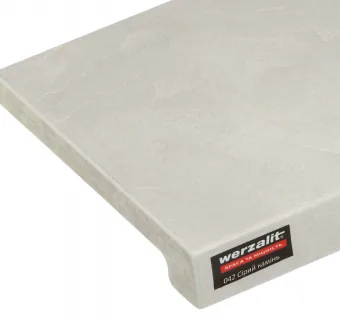
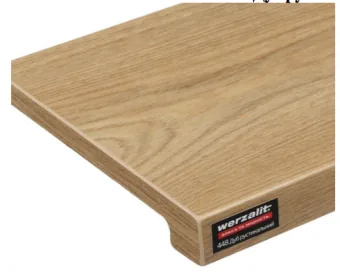
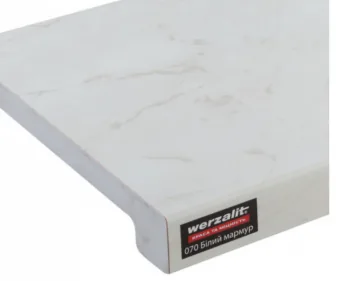
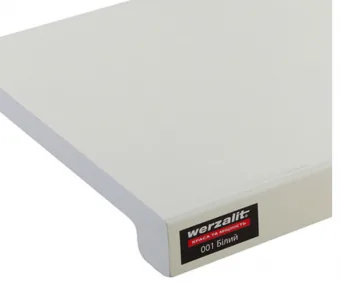
Pressed wood with a monolithic surface (Werzalit)
Here the core and the surface are made together: wood chips (usually softwood and beech) are mixed with natural polymer resins and pressed under high temperature and pressure. The multilayer surface is pressed in the same process, so the top layer is not glued on but fuses with the core and one board results. The technology has been used in Germany for over 60 years.
- Pros: according to the manufacturer it resists moisture, temperature swings, scratches and household detergents, tolerates heat up to 180 °C briefly, many decors (wood, stone, marble, plain).
- Cons: more expensive than PVC; heavier than plastic though much lighter than stone; the cut must be closed with end caps and sealant.
- Suits: a kitchen, a children’s room, a living room, an office and a café: wherever the sill is really loaded.
Series and prices: Werzalit windowsills.
The main weakness of almost any material is the cut edge
However many layers and films there are, a windowsill always has a place where the surface ends and the material itself shows: the ends and the places where it was cut. That is where water gets in. So when choosing a material ask not only “what is on the surface” but also “what happens at the cut edge”.
For site managers and designers
- Establish the humidity and load of the room: a kitchen and a bathroom call for the top class, a dry living room allows a budget option.
- If the sill continues the worktop or serves as a bar counter, specify a material with reserve for heat and wear.
- In the specification give the material, decor, width, edge type and kit (end caps, connector) as separate items.
- Check colours against samples in daylight: on a screen the decors look different.
Summary table
| Material | Moisture | Heat | Scratches | Weight | Price |
|---|---|---|---|---|---|
| Solid wood | Weak | Good | Medium (can be sanded) | Medium | High |
| Chipboard/MDF in laminate | Weak (the cut) | Medium | Medium | Medium | Low |
| PVC | Good | Weak | Weak | Light | Low |
| Artificial stone | Excellent | Good | Good (can be sanded) | Heavy | High |
| Natural stone | Good (marble absorbs) | Excellent | Good | Very heavy | High |
| Werzalit | Good | Good | Good | Medium | Medium |
The ratings are generalised: specific properties depend on the manufacturer and the model.
Which material to choose by room
| Room | What matters | A sensible choice |
|---|---|---|
| Kitchen | Heat, moisture, grease, detergents | Werzalit, artificial stone |
| Living room, bedroom | Looks, price | Werzalit; on a budget and in a dry room: MDF, wood |
| Children’s room | Toughness, safety, easy cleaning | Werzalit |
| Bathroom, toilet | Constant moisture | Werzalit, PVC, stone |
| Balcony, storeroom | Price, moisture | PVC or Wermodin Gentas |
| Office, café | Wear resistance, easy care | Werzalit |
A five-minute material check
If you buy a sill in a shop or accept an order on site, five simple actions are enough:
- Look at the cut edge. It should be even, without chips or delamination.
- Run your palm over the surface. No waves, bubbles or “orange peel”.
- Lay the piece on a flat floor. There should be no gap under the edges: a bend means a poor core.
- Inspect the edge and the nose. They are the same along the whole length.
- Compare the colour in several places in daylight.
How to tell a good windowsill
- The surface is flat, without waves and bubbles, and the colour is the same along the whole length.
- The cut is clean, without chips and ragged edges.
- The dimensions match the declared ones: the thickness and the nose are the same along the length (for Exclusive these are 17 mm and 25 mm, more in the article “What the nose is”).
- End caps are included and match the colour.
- The manufacturer and the country of origin are known. Werzalit Exclusive and Compact are made in Germany, Wermodin Gentas in Turkey.
How to measure a window and choose the width is in the article “How to measure a window and choose a windowsill”, and about care in “Caring for a windowsill”.
Frequently asked questions
Which material suits a kitchen best?
A kitchen needs resistance to moisture, grease and heat. Artificial stone and pressed wood with a monolithic surface such as Werzalit answer that well.
Which windowsill material is the most durable?
Stone (natural and artificial) and pressed wood with a monolithic surface withstand moisture, heat and load best. The most vulnerable are chipboard in laminate when water gets into the cut and plastic under strong heat.
How does Werzalit differ from ordinary chipboard?
According to the manufacturer, the mass of chips and resins is pressed under high temperature and pressure together with a multilayer surface, and the surface fuses with the core rather than being glued on as with laminate. That is why such a board resists moisture and wear better.
Is a PVC windowsill suitable?
Yes, if you need an inexpensive sill without heavy load and strong heat. For a kitchen and for places where a lot stands on the sill, Werzalit is more reliable.
Can a windowsill be used as a worktop?
Yes, in a kitchen this is a common solution, especially with a tough material. See also Werzalit worktops.